Showing posts with label Students. Show all posts

Monday, November 18, 2013

Tests for Divisibilty


Maybe I am getting old, and don't remember how to test numbers for divisibility, but I have learned some really cool tricks that I would like to now share. I will be explaining how to test for divisibility by 2,3, 4,5,6,7,8,and 10. You can find a convenient Divisibility Rules Table here, which I have a printed copy of and have placed on my refrigerator for my step-son that we use quite frequently!

To test a number to see if it is divisible by 2:

You simply look at the last digit in your number, if the last number is any multiple of 2 (0,2,4,6,8) than your number can be divided by 2.


To test a number to see if it is divisible by 3:

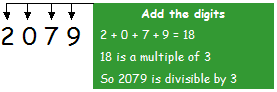
You take your given number and add up all the digits, if the sum of digits is a multiple of 3, you have a number that is divisible by 3.

To test a number to see if it is divisible by 4:

You take the last two digits of a number and add them together, if the sum is a multiple of 4, you have a number that is divisible by 4.


To test a number to see if it is divisible by 5:

Check to see if the last digit of given number is a 5 or a 0.


To test a number to see if it is divisible by 6:

Look at the last digit of your given number, decide if it can be a multiple of 2 or 3. For which ever one it is  multiple of, you then add up all the digits, if the sum of digits is multiple of 2 or 3, your number is divisible by 6.


To test a number to see if it is divisible by 7:

You will want to subtract 2 times the last digit from the other digits. 

224: 22-8=14

To test a number to see if it is divisible by 8:

Check to see if the last 3 digits of your number add up to a sum that is a multiple of 8.

587320 is divisible by 8 because 320 is divisible by 8.

To test a number to see if it is divisible by 9:

Add all the digits of the number in question, check to see if it is a multiple of 9.


To test a number to see if it is divisible by 10:

Look at the last digit in the number you are given, if it ends in 0 than it is divisible by 10.




Division as Repeated Subtraction

Division has got to be my worst fear when it comes to math. When I was younger, I learned how to divide by doing the classic long hand method. This was incredibly time consuming, and confusing; if you misplaced just one number, the entire problem is wrong and you end up having to start all over. Most of the time I would get so frustrated that I would just whip out my calculator and solve the division problems without really understanding the method. But, as an adult I have learned about a new way math teachers are teaching division, through repeated subtraction

One way to use the repeated subtraction method is by subtracting off as many hundreds as you can, then tens, and then ones. This method would look like my example below:


Another way to use the repeated subtraction method is my subtracting the divisor from the dividend until you reach zero, or close to zero. The video below does a wonderful job of illustrating this:


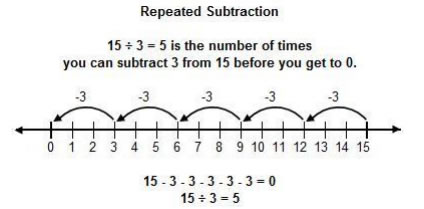
The last method I have discovered for using the repeated subtraction is by using a simple number line. The picture example below shows how this would be done:


Looking at division problems this way makes it much less scary, confusing, and time consuming. The fact that the repeated subtraction to solve division problems has three different ways makes it even more important for us as teachers to be utilizing in the classroom. As an educator myself, I know that children all learn differently, and I believe that teaching division as repeated subtraction and having three different ways to accomplish is great because some students may find using the number line way more suited to them, or some may prefer the subtracting of the divisor from dividend, and if all else fails, some may be more comfortable using the subtracting of hundreds, tens, and ones to their liking. In my future classroom I fully intend on using this method in teaching my students division!


Expanded Notation for Multiplying Whole Numbers

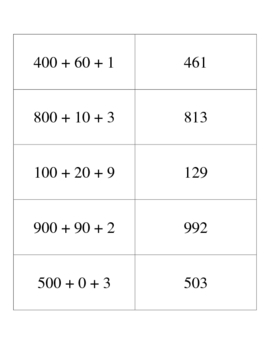
Using Expanded Notation has got to be the best way I have seen for solving multiplication problems! It is so easy and simple to use, and you can solve your problems faster and with accuracy. Below are some pictures of what large numbers look like in  Expanded Notation. (I like the idea of using expanded notation for large number multiplication; makes it much less confusing and time consuming)


I find this to be a very clever way to be teaching students place value, by breaking down the numbers into their respective parts (hundreds, tens, and ones). 

Now when multiplying, lets say with a problem like 8x469, you would first start with converting 469 into Expanded Notation which would look like so:

400+60+9=469

Now that we know what 469 looks like in Expanded Notation we can move onto our next step of the problem. We need to now multiply our 469 by 8, and to do this we would put our Expanded 469 into parenthesis and write 8 before it like so:

8x(400+60+9)

From here the next step is to distribute the 8 through the parenthesis, and would look like this:

8x400+8x60+8x9

From here you would solve each multiplication problem, looking like this:

3,200+480+72

To finish you just go through and add up everything giving you your answer of:  3,752

I personally have used this method while helping the school-aged children at my place of employment, and with much success. At first, it is overwhelming, but after a couple of days they no longer need my help (which makes me kind of sad). I wish that when I was younger I could have been taught this way to do multiplication problems. I am stuck in the long-hand way of doing multiplication, so doing this at first was very hard for me to get used to. But, through using this method with the students I tutor at work, I have come to always use this method for multiplying. Study Jams is a wonderful website that offers students training, and testing on expanded notation I myself have used this website many times in helping my step-son practice writing numbers in expanded notation for many math assignments.